
09 April 2026
Every city has its blind spots. Not the parts that are broken or neglected but the parts that are invisible. The crossings, corridors, staircases, running tracks, and building entrances. The 30 seconds of floor between you and wherever you're actually going.
Nobody designs for these spaces or talks about them in sustainability strategies. And yet, collectively, they're walked across millions of times in every city and every country.
That's not dead space. That's an untapped network.
Pavegen exists to activate it and the results go well beyond what most people expect when they first hear "kinetic flooring." Yes, footsteps generate electricity. But that's almost the least interesting part of what's happening. Here's what the technology is actually doing in the real world.
1. Crossings
Case Study: Dupont Circle, Washington D.C.
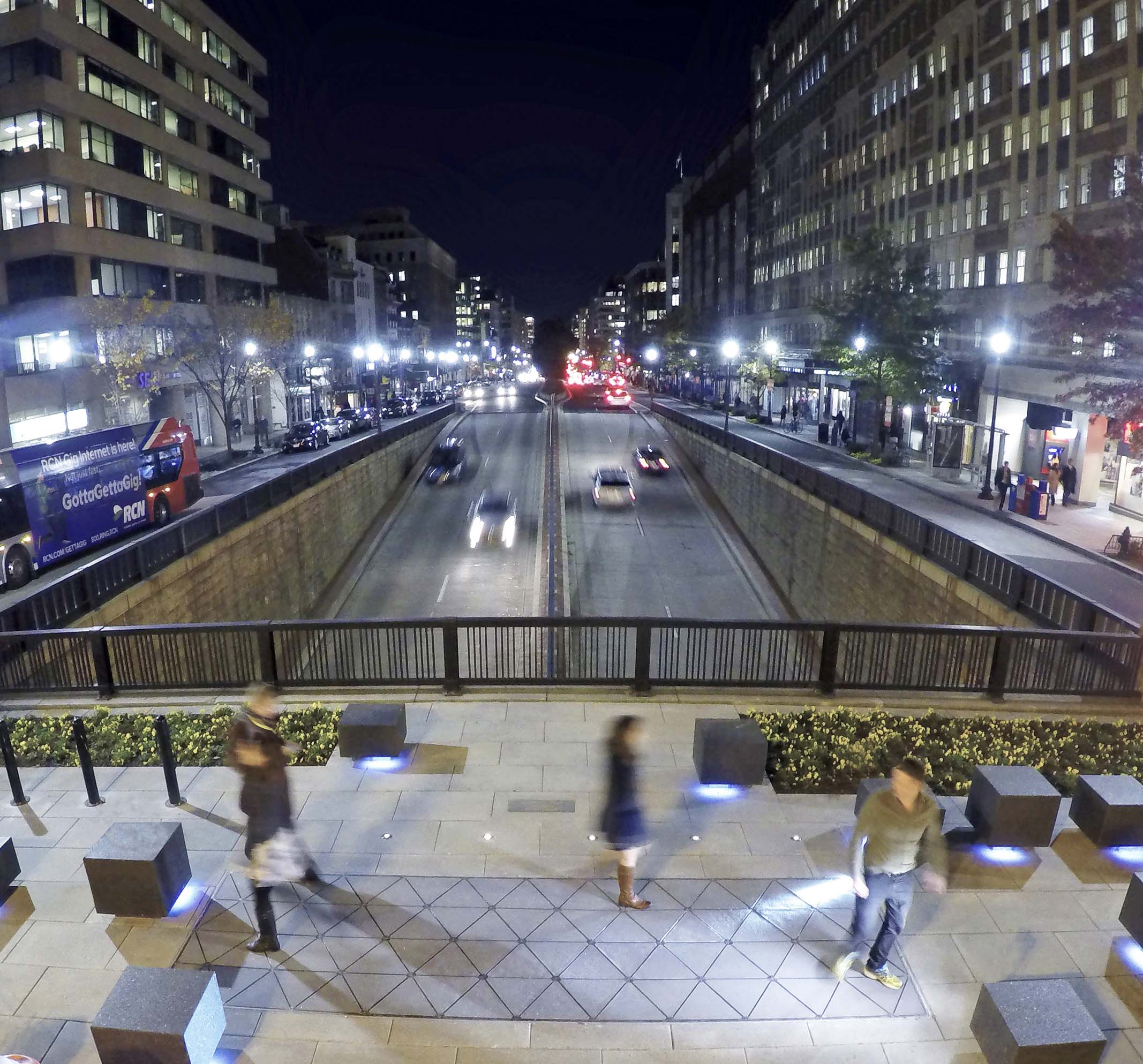
A pedestrian crossing a few blocks from the White House doesn't sound like the most exciting canvas for urban innovation. But it was exactly the kind of space Pavegen was built for; high footfall, zero design ambition, and enormous untapped potential.
Pavegen embedded kinetic tiles along the crossing, turning footsteps into off-grid electricity that powered nearby lighting. But the energy was secondary to what the installation was really doing: building a live picture of how people actually move through the city.
Every step generated anonymised data on pedestrian flow, relayed directly to Washington D.C. Transport. For a city trying to optimise everything from traffic signals to public safety, that kind of granular, real-time behavioural data is valuable. It's the difference between guessing how people use a space and actually knowing.
The crossing also became interactive. Lights responded to footsteps in real time, turning a forgettable transit moment into something people noticed, paused at, shared. Dwell time increased. People talked about it.
Street furniture was added to bring the story to life with LED lighting; a working demonstration of what smart-city infrastructure can look like when it's designed around human movement.
2. Staircases
Case Study: Taylor’s University, Malaysia
The problem with sustainability education is that it usually lives at a distance. It's in lectures, in reports, in targets set by people students will never meet. It rarely shows up in the middle of a Tuesday.
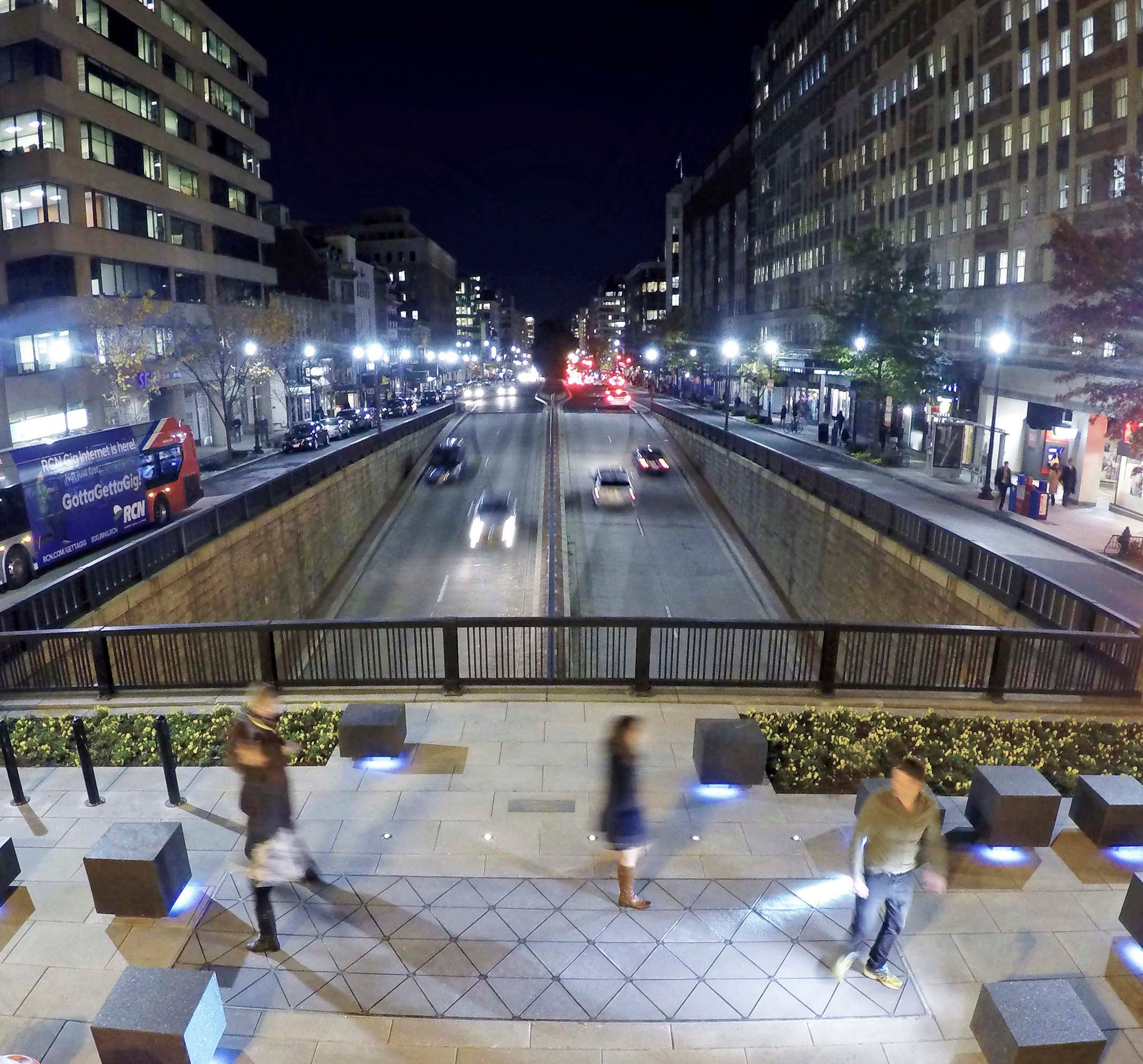
Taylor's University wanted to change that. Their answer wasn't a new course or a campaign - it was a staircase.
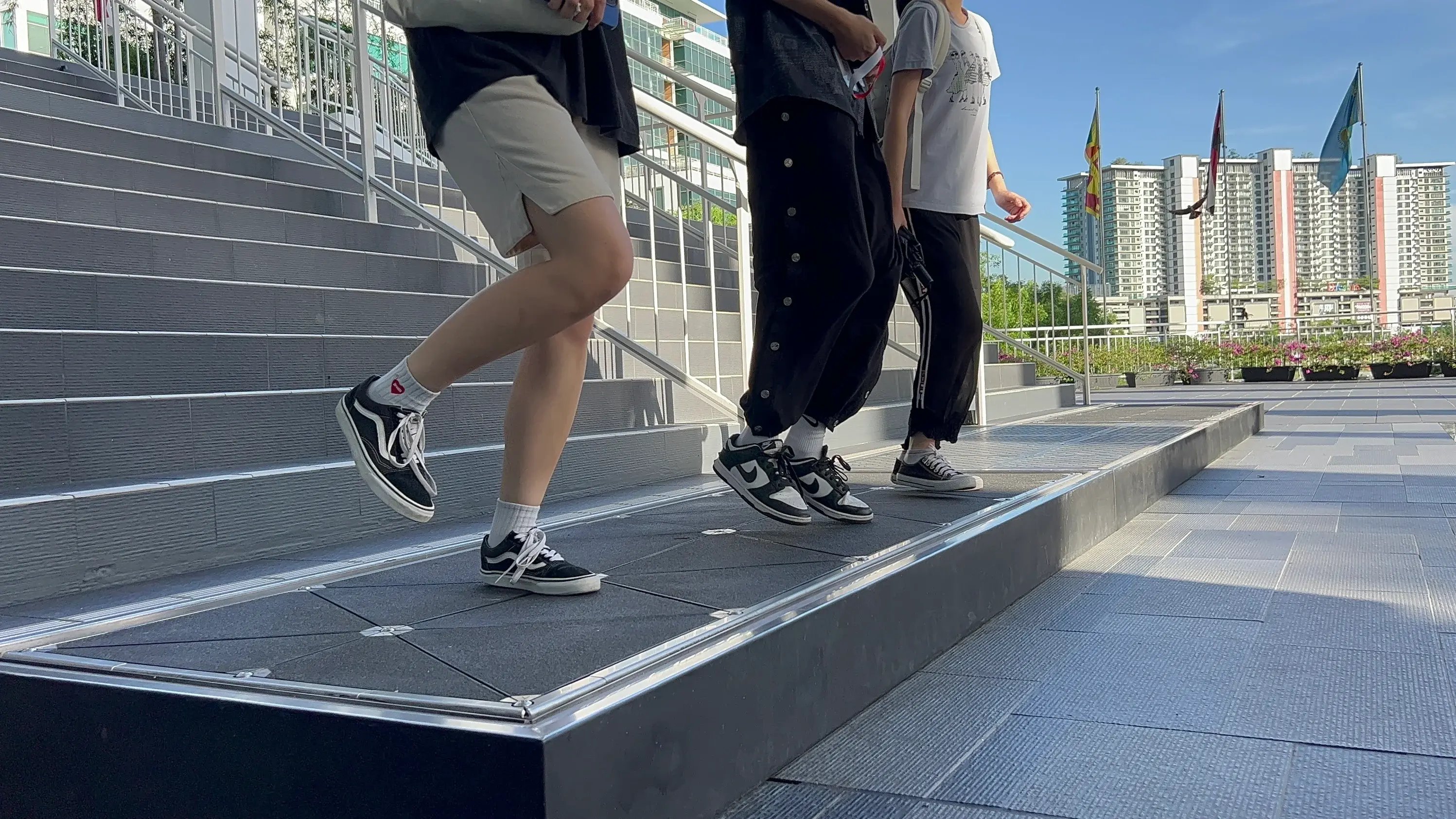
Pavegen installed kinetic tiles at the base of a high-traffic staircase at the heart of campus. Each step lit up the bannister lighting. A nearby screen translated footsteps into live energy data displaying how much had been generated and what it added up to over time.
The result wasn't just a cool feature. It shifted how students related to the concept of energy. Instead of something abstract that happens in power stations and on excel sheets, it became something they could see themselves generating.The staircase became a social space, something nobody could have predicted when the brief was written.
When you make sustainability something people can feel in a routine moment rather than read about on a poster, something changes. Curiosity turns into ownership. A staircase becomes a syllabus. And the people walking through the space become the very case study others will one day analyse.
3. Running Tracks
Case Study: The Quayside, Hong Kong
In Hong Kong, outdoor space is scarce, weather is unpredictable, and keeping residents and workers active rather than just giving them access to a treadmill is harder than it sounds.
The Quayside had a more ambitious goal than "put a gym in the building." They wanted to create a space that motivated people, connected them to each other, and gave movement a sense of purpose beyond personal fitness.
The world's first indoor Pavegen running track was the answer.
And for those who wanted to go deeper, The Quayside app unlocked a whole new layer of engagement, displaying individual energy stats, personal progress tracking, and even leaderboards that turned casual laps into friendly competition.
That shift, from individual exercise to shared contribution, is what makes it work. People don't just run their loop and leave. They check the app. They come back to beat yesterday's number. They bring their colleagues. The data creates a quiet sense of competition and community that a standard gym corridor never could.
For building managers, it also generates detailed insight into how and when the space is used, which informs everything from programming decisions to energy planning.
A running track that used to be a nice amenity is now a community dashboard, a wellness driver, and a piece of live infrastructure all in the same strip of tiles.

4. Building Entrances
Case Study: Citi Tower, Hong Kong
Every major commercial building has an ESG strategy. Very few of them have a way of communicating it that doesn't involve a plaque on a wall or a line in the annual report.
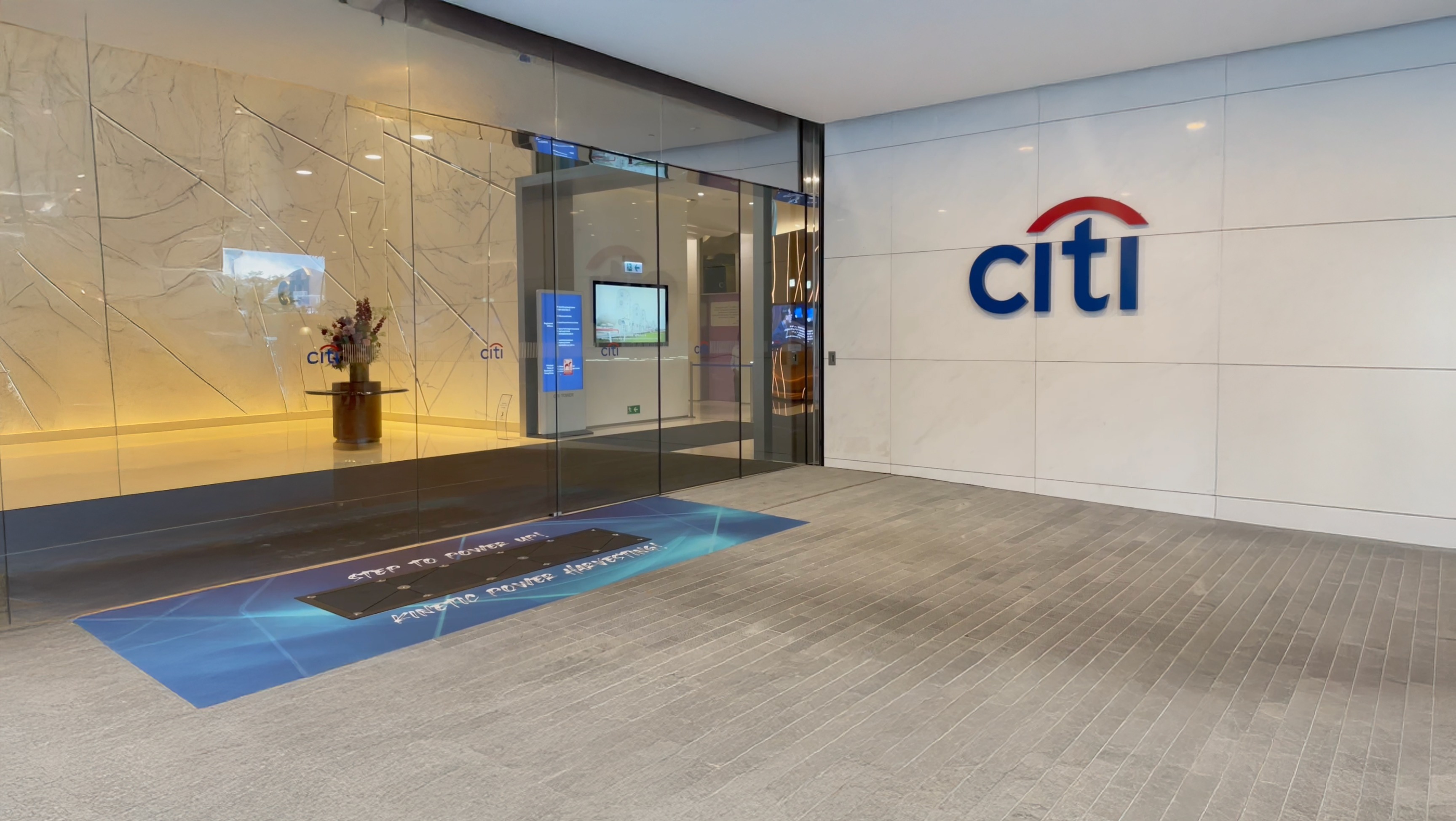
Citi Tower wanted their sustainability commitment to be experienced, not explained. The entrance where thousands of employees, clients, and visitors arrive every single day was the obvious place to do it.
Pavegen installed a kinetic walkway across the main building entrance with a digital screen in the lobby that updates in real time: live energy generation, total footsteps, real-world equivalents, cumulative impact. The moment you walk in, the building responds to you. It sounds simple. The effect is surprisingly powerful.
For employees, it creates a daily ritual, a small but tangible reminder that the building they work in is measuring and using their movement. For clients and visitors, it's an instant conversation starter that communicates more about the building's values in three seconds than any signage ever could.
ESG stops being a story told once a year in a document. It becomes something the building demonstrates every morning, in the lobby, to every single person who walks through the door, without having to say a word.
4. Corridors
Case Study: Vanderbilt University, USA
Corridors are the ultimate in‑between spaces. Nobody visits a corridor. Nobody remembers one. They exist purely to move people from where they are to where they actually want to be. At Vanderbilt University - a campus known for research and innovation - that made a busy interior walkway the perfect place to rethink what everyday movement could mean.
The challenge wasn’t to redesign the space. It was to give it purpose.
Pavegen installed a strip of kinetic tiles along a high‑traffic corridor used daily by students, faculty and visitors. A space that once blended into the background suddenly had a new role: capturing energy from every footstep and turning routine movement into measurable impact.
What made the installation work wasn’t spectacle - it was subtlety. Students didn’t have to stop, slow down or change their behaviour. They simply walked the way they always did, and the corridor responded. Energy was generated. Data was captured. A once‑invisible space became a quiet demonstration of how human movement can support a smarter campus.
For Vanderbilt, the installation wasn’t just about energy. It was about culture, showing that innovation doesn’t always require new buildings or new systems. Sometimes it just requires looking at the spaces we already have and asking more of them.
A corridor that once existed purely for movement now creates engagement, awareness and a sense of shared contribution, all without changing the way people move through their day.
.png?width=2000&height=1143&name=E-NEWS%20ASSETS%20(18).png)
The Bigger Picture
The technology is kinetic flooring. But what it's actually building is something more significant: a new layer of intelligence across the spaces cities have always treated as afterthoughts.
The data Pavegen surfaces - pedestrian behaviour, movement patterns, energy generation, community engagement - feeds into the decisions that make buildings more efficient, campuses more connected, and cities more responsive. It turns passive infrastructure into active infrastructure, and it does it in the one place nobody thought to look: the floor beneath your feet.
Every crossing. Every corridor. Every staircase. Every entrance.
None of it is dead space.