

How to Measure ROI of Brand Activation: 2026 Guide
18 April 2026
The ROI Problem That Is Costing Experiential its Seat at the Table
Ask ten brand managers how they measure the ROI of their last brand activation and you will get ten different answers or, more commonly, a long pause. Experiential marketing has a measurement problem. Not because the results are not there, but because the industry has historically lacked a consistent framework for capturing and reporting them.
The consequence is predictable: when budget season arrives, experiential is the first line item to get cut. Without clear ROI evidence, activation spend looks like a cost rather than an investment. The good news is that this is entirely solvable. Modern experiential marketing technology for events now produces real-time data that answers the ROI question with precision.
Why Brand Activation ROI Is Hard to Measure
The measurement challenge in experiential marketing stems from three structural problems that have historically made activation ROI opaque.
1. Multiple objectives, no single metric
Unlike a digital ad campaign where click-through rate and conversion are the universal currency, brand activations serve multiple objectives simultaneously: awareness, sentiment, data capture, sustainability storytelling, lead generation, and earned media. A single metric cannot capture all of these.
2. Passive technology produces passive data
A booth with a branded backdrop generates footfall but you can only count the people who walked past, not the ones who stopped, engaged, and left with an altered brand perception. Traditional activation formats produce reach data at best.
3. No standard reporting framework
Without a consistent post-event reporting template, every activation gets reported differently. One client gets a social media reach figure. Another gets a footfall count. A third gets a press coverage summary. None of these are comparable, and none of them answer the fundamental question: was the investment worth it?
The Four-Layer Brand Activation ROI Framework
The most robust approach to measuring brand activation ROI uses a four-layer framework that captures different dimensions of value at different points in the audience journey. This framework has been adopted by leading experiential agencies and brand teams precisely because it maps to the multiple objectives of a live activation without forcing a single-metric simplification.
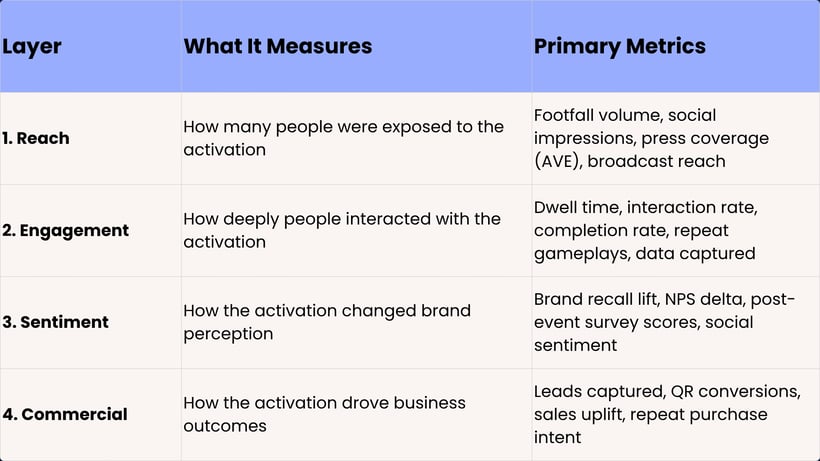
Not every activation will deliver on all four layers with equal strength, and not every client needs all four. But building the measurement framework around all four layers from the outset, even if some dimensions are tracked more lightly than others, ensures that the post-event report captures the full value of the investment.
(See 10 interactive brand activation ideas that prove ROI.)
Key Benchmarks: What Good Looks Like
One of the most common barriers to meaningful ROI measurement is the absence of benchmarks. Without a reference point, a dwell time of three minutes could be exceptional or mediocre, you have no way of knowing. The following benchmarks, drawn from published industry research, provide the baseline against which activation performance can be assessed.
-
-
Dwell time: The industry benchmark for interactive brand experiences is three to four minutes of average dwell time per participant (Forrester Research). By comparison, digital display advertising generates an average of 1.7 seconds of attention.
-
Purchase intent: 98% of consumers are more likely to purchase from a brand after attending one of their live activations (EventTrack, 2022). This figure is not a guarantee of conversion, but it establishes that positive experiential engagement is among the most powerful predictors of commercial intent available to a brand.
-
Earned media multiplier: Earned media generated by experiential activations can deliver up to 10x the value of paid media equivalents (Forbes). For activations that generate significant social sharing or press coverage this multiplier transforms the ROI calculation entirely.
-
Repeat engagement rate: For gamified activations, the repeat engagement rate (the percentage of participants who interact more than once) is a powerful leading indicator of brand sentiment.
-
How to Set Up Your Measurement Framework Before the Event
Effective ROI measurement begins before the activation goes live. Brands and agencies that try to reconstruct the data after the event consistently underreport results because the right capture mechanisms were not in place. Here is the pre-event measurement checklist.
Step 1: Define your primary and secondary objectives. For each activation, identify one primary objective (e.g. brand awareness at scale) and two to three secondary objectives (e.g. sustainability data capture, lead generation).
Step 2: Identify your data capture mechanisms. What technology will capture your engagement data? Identify any gaps, particularly for sentiment data, which typically requires a post-event survey or social listening tool.
Step 3: Set baseline figures. Before the event, establish baseline brand awareness and sentiment scores for your target audience segment. Post-event survey data is only meaningful if you have a pre-event benchmark to compare it against.
Step 4: Agree the reporting template with your client. Agree in advance which metrics will appear in the post-event report, how they will be calculated, and what success looks like for each.
How Pavegen Makes Brand Activation ROI Automatic
 The most significant barrier to robust activation ROI measurement is that capturing the data has historically required manual effort: clicker counters, survey teams, social listening subscriptions, and post-event analysis that takes weeks to compile.
Pavegen’s kinetic technology fundamentally changes this. Every Pavegen installation, including the Gamestation, captures the following data automatically and in real time:
-
-
Total footfall volume: the number of individual steps recorded across the activation.
-
Energy generated: joules of electricity produced, with carbon equivalent calculation.
-
Dwell time distribution: how long participants engaged with the activation.
-
Peak engagement periods: when the activation was busiest, useful for staffing and scheduling future events.
-
Gamification metrics: completion rates, leaderboard positions, repeat plays.
-
This data feeds into Pavegen’s post-event reporting package, covering all four layers of the ROI framework: reach, engagement, sentiment, and commercial.
For agencies, this means a faster, richer post-event report that makes the case for repeat activation budgets. For brands, it means an ESG-reportable data asset that supports both marketing and sustainability functions. And for clients presenting to boards, it means numbers that answer the ROI question without hedging.
Measurement Is Not Optional
The brands and agencies leading the experiential market in 2026 have figured out something that their competitors have not: measurement is not what you do after a brand activation. It is what you build into it from the start. The technology that captures your ROI data is as important as the technology that creates the experience.
The four-layer framework gives every brand and agency a consistent, credible structure for reporting activation performance. Pair it with technology that captures the data automatically, and the ROI conversation stops being a problem and starts being a competitive advantage.